Swahili
Vintage Turntables Are Often Compared on These Details
Imeundwa 03.16
We all cherish the rich audio quality found in older stereo systems. Finding the right gear for our music room is a rewarding experience for us as collectors.
vintage turntable
When we compare turntables, we look at motor stability and stylus wear. These details help us pick a model that sounds great and keeps its value.
We aim to explain the technical details of these classic machines. We want to help you make an informed choice for your home collection. And enjoy every record you own.
Key Takeaways
- Motor drive types significantly affect speed consistency.
- Base weight improves overall sound stability and reduces vibration.
- Tonearm quality directly impacts your record health and tracking.
- Maintenance history matters for long-term mechanical use.
- Original parts help preserve the classic value of the unit.
- Cartridge options change the sonic warmth of the audio output.
1. Drive System Type: Belt Drive vs Direct Drive
Understanding the drive system type is key to appreciating vintage turntables. The drive system greatly affects a turntable's performance and sound quality.
The debate between belt drive and direct drive turntables has been ongoing. Each type has its own characteristics, advantages, and disadvantages.
Belt Drive Mechanisms and Their Characteristics
Belt drive turntables are known for reducing motor noise and vibration. This can lead to a cleaner sound. The belt drive mechanism isolates the motor's vibration from the platter, resulting in a more stable rotation.
Key characteristics of belt drive turntables include:
- Reduced motor noise and vibration
- Improved sound quality due to isolation from motor vibration
- Generally considered more suitable for home listening environments
Direct Drive Technology and Performance
Direct drive turntables offer superior torque and speed stability. They are ideal for DJs and those who require consistent performance. The direct drive mechanism connects the motor directly to the platter, providing a more stable and consistent rotation.
Key characteristics of direct drive turntables include:
- Superior torque and speed stability
- Ideal for DJing and applications requiring consistent performance
- Often preferred by professionals due to their reliability and consistency
Comparing Sound Quality and Maintenance Needs
When comparing belt drive and direct drive turntables, sound quality and maintenance needs are crucial. Belt drive turntables are often praised for their warm and detailed sound. Direct drive turntables are known for their accuracy and consistency.
A comparison of sound quality and maintenance needs:
Feature | Belt Drive | Direct Drive |
Sound Quality | Warm and detailed | Accurate and consistent |
Maintenance Needs | Belt replacement required over time | Generally more durable, less maintenance |
In conclusion, the choice between belt drive and direct drive vintage turntables depends on individual preferences and needs. By understanding the characteristics of each type, enthusiasts can make informed decisions when selecting a vintage turntable.
2. Tonearm Design and Quality
The tonearm's design and quality are key in vintage turntables. They affect the sound quality and user experience. The tonearm tracks the grooves on a record, impacting the sound fidelity.
Tonearm Materials and Construction Methods
The materials used in tonearms matter a lot. Aluminum, carbon fiber, and metals are common. Each has its own benefits like weight, durability, and resonance.
Aluminum tonearms are light and rigid. Carbon fiber ones are good at damping and resisting resonance.
Tonearm construction methods are also crucial. Precision and detail are needed to avoid unwanted resonances and ensure smooth tracking.
Effective Mass and Tracking Capabilities
The effective mass of a tonearm is important. It affects how well it tracks the record grooves. The right effective mass for the cartridge ensures the best sound quality.
Too little effective mass can cause poor tracking. Too much can wear out the stylus and record.
Tracking capabilities also depend on the tonearm's bearing quality. High-quality tonearms have precision bearings and adjustable tracking force for better performance.
Manual, Semi-Automatic, and Fully Automatic Operation
Tonearms can be manual, semi-automatic, or fully automatic. Manual tonearms need the user to place the tonearm on the record. They offer control but require effort. Semi-automatic tonearms automate lifting and returning. Fully automatic tonearms do everything from start to finish.
S-Shaped vs Straight Tonearms
The debate is between S-shaped and straight tonearms. S-shaped ones are designed for better tracking by aligning the cartridge with the record groove. Straight tonearms use different designs for similar results.
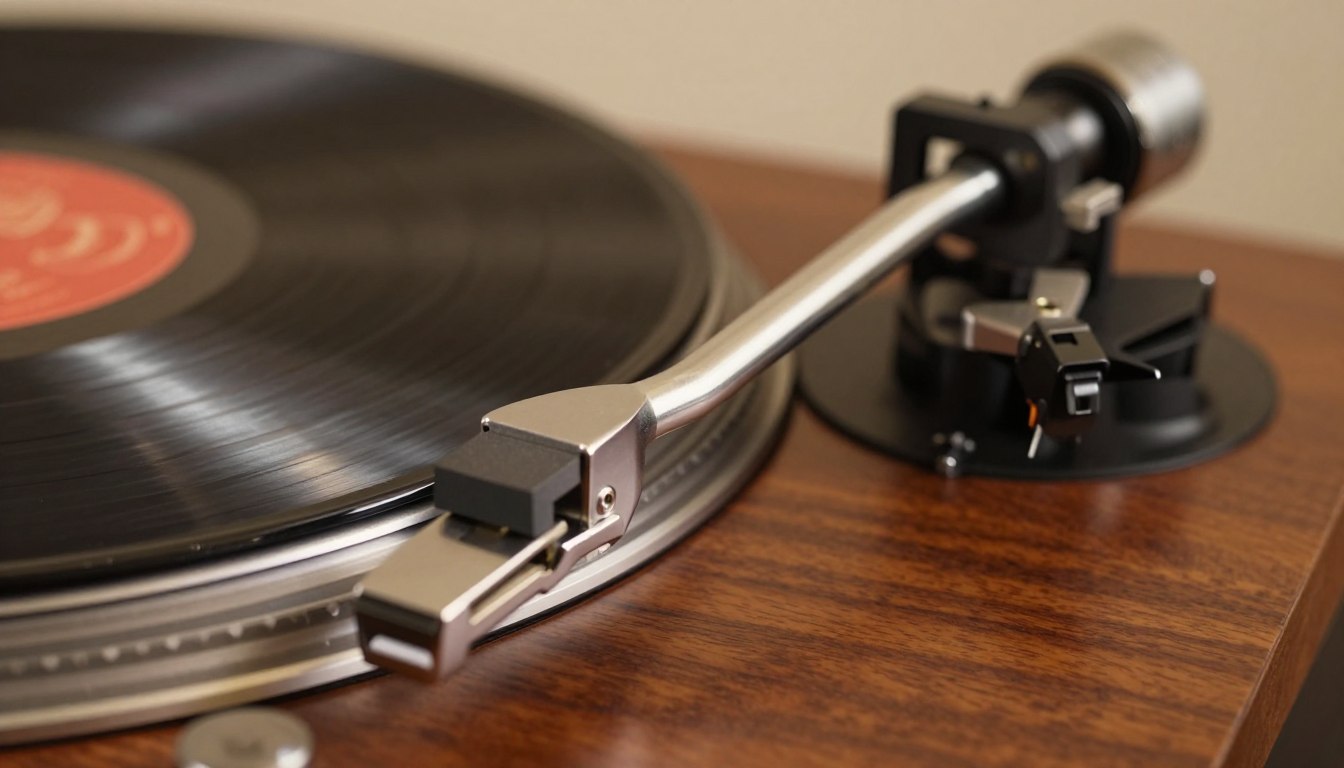
A close-up view of a sophisticated vintage tonearm design, showcasing intricate craftsmanship and precision engineering. The foreground highlights the tonearm, featuring polished metal components, a sleek geometric shape, and fine detailing such as the cartridge and stylus assembly. The middle ground includes a classic turntable base with rich wood grain and luxurious finishes, accentuating the aesthetic appeal. In the background, softly blurred vinyl records create an atmosphere of nostalgia and music appreciation. The lighting is warm and inviting, with gentle highlights reflecting off the metallic surfaces, enhancing the elegant curves and contours of the tonearm. Capture the essence of vintage audio quality, evoking a mood of refinement and appreciation for audio engineering.
Tonearm Type | Tracking Performance | Aesthetic Appeal |
S-Shaped | Optimal tracking due to better cartridge alignment | Classic design, often considered more visually appealing |
Straight | Can offer precise tracking with linear tracking mechanisms | Modern appearance, may appeal to those looking for a sleek design |
3. Build Quality and Construction Materials of Vintage Turntables
Vintage turntables last longer and sound better because of their build quality and materials. A well-made turntable is a great investment for vinyl lovers. It offers both quality sound and durability.
Plinth Design and Material Composition
The plinth, or base, is key for a turntable's stability and resistance to vibrations. Common materials include MDF (Medium-Density Fibreboard), wood, and metal. Each has its benefits: MDF is dense and dampens vibrations, wood adds elegance and absorbs resonances, and metal is strong and durable.
Looking at a vintage turntable's plinth can tell you a lot about its sound quality. A solid plinth reduces vibrations that can harm sound.
Platter Construction and Weight Distribution
The platter is vital for a turntable's performance. A heavier platter rotates more stably, reducing wow and flutter. Aluminum and brass are popular for platters because they're dense and dampen vibrations well.
- Aluminum platters are light and found in more affordable turntables.
- Brass platters are denser, offering better stability and are in higher-end models.
Overall Component Quality and Engineering
The quality of a vintage turntable also depends on its components, like the motor, tonearm, and bearings. High-quality parts ensure better performance and longer life.
Isolation and Vibration Damping Features
Many vintage turntables have features to block external and internal vibrations. These include spring suspension systems and rubber feet. These features are key for maintaining sound quality, even in noisy places.
Good isolation and vibration damping help the turntable sound clear and nuanced. This is crucial for a great listening experience.
4. Motor Performance and Speed Accuracy
A turntable's motor is its heart, and its performance affects how we listen. The motor's steady speed is key for accurate playback.
Wow and Flutter Specifications
Wow and flutter show how steady a turntable's speed is. Wow is about slower speed changes, and flutter is about faster ones. These are important for sound quality. A turntable with low wow and flutter values sounds better.
When looking at old turntables, check their wow and flutter specs. A lower number means better sound. For example, under 0.1% is usually good.
Motor Types and Their Longevity
Turntables use different motors, like DC motors and AC motors. DC motors are stable and last long, while AC motors are simpler and cheaper. The motor type affects the turntable's performance and life.
Some vintage turntables, like those from VPI, have high-quality motors. These motors ensure great speed stability and long life.
Speed Stability and Adjustment Options
Speed stability is crucial for correct pitch playback. Some turntables have adjustments, like pitch control, for fine-tuning. This is great for DJs who need to match record pitches.
Quartz Lock and Pitch Control Features
Quartz lock technology uses a quartz crystal for precise speed control. It keeps the turntable's speed stable, even when conditions change. Pitch control lets you adjust the speed for various uses, from DJing to audio calibration.
When checking out a vintage turntable, look for quartz lock and pitch control. These features ensure the turntable meets your needs for speed accuracy and stability.
5. Cartridge Compatibility and Upgrade Options
Knowing about cartridge compatibility is key to getting the best sound from your vintage turntable. The cartridge greatly affects sound quality. Picking the right one can really make a difference.
There are two main types of cartridges: moving magnet and moving coil. Each has its own strengths and benefits.
Moving Magnet vs Moving Coil Support
Moving Magnet (MM) cartridges are common and work well with many vintage turntables. They have a high output voltage and match many phono preamps.
Moving Coil (MC) cartridges are loved for their detailed sound. But, they need a special phono preamp or transformer because of their low output voltage.
When picking between MM and MC cartridges, think about a few things:
- Output voltage and your phono preamp
- What sound quality you prefer (warm or detailed)
- Upgrade and replacement options for your vintage turntable
Mounting Standards and Headshell Types
Vintage turntables have different mounting standards and headshell types. This can affect cartridge compatibility. Common standards include:
- Standard 1/2-inch mounting
- Special mounts for certain brands
Make sure the cartridge you pick fits your turntable's mounting standard and headshell type.
Stylus Replacement and Upgrade Paths
The stylus is a key part of the cartridge. Replacing or upgrading it can greatly improve sound quality. Look for:
- Compatibility with your current cartridge
- Better sound quality or durability
- Easy installation and adjustment
By understanding cartridge compatibility and upgrade options, you can enhance your vintage turntable's sound. Enjoy a richer, more detailed listening experience.
6. Brand Heritage, Condition, and Value Considerations
Vintage turntables are loved for their brand heritage, condition, and value. It's important to look at their history and the reputation of their makers. This goes beyond just how well they work.
Legendary Brands and Their Flagship Models
Some brands are known for making top-notch vintage turntables. These legendary brands have created models that collectors and music lovers want.
Technics Direct Drive Turntables
Technics is famous for its direct drive turntables. They are known for being accurate and durable. The Technics SL-1200 is a classic in DJing and is highly valued for its quality and reliability.
Thorens Belt Drive Models
Thorens is known for its belt drive turntables. They are loved for their warm sound quality. Models like the Thorens TD 150 are favorites among audiophiles for their sound and build.
Pioneer, Dual, and Other Notable Manufacturers
Pioneer and Dual are also well-known. They have made iconic turntables that are still loved today. Pioneer's PL-12 and Dual's CS 505 are examples of highly respected models.
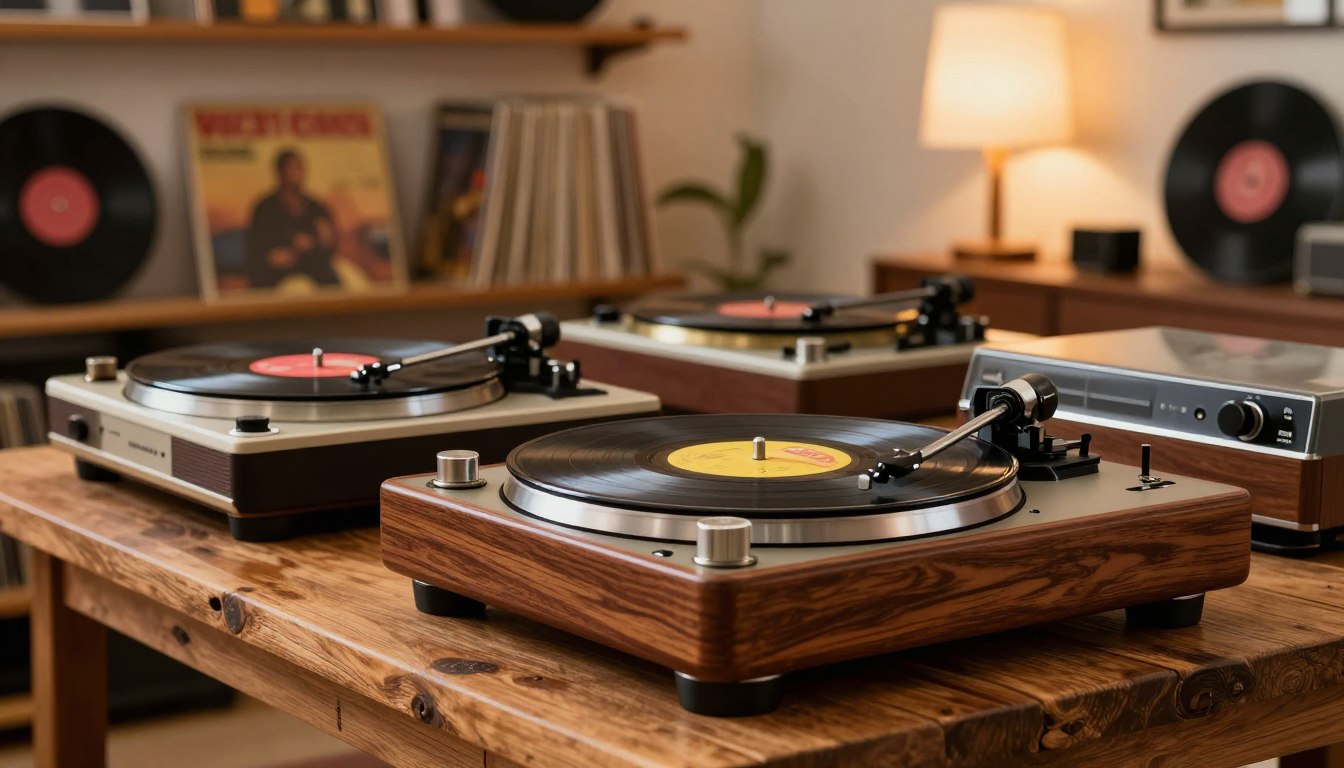
A beautifully captured vintage turntable display arranged on a rustic wooden table. In the foreground, a classic turntable from the 1970s stands prominently, showcasing intricate details like polished wood finish, shiny metal components, and a vibrant, colorful record on the platter. The middle layer features an assortment of well-known vintage turntable brands, each with their distinct logos subtly visible, enhancing the narrative of brand heritage. The background presents a softly blurred setting of a cozy music room, adorned with classic vinyl records on shelves, warm lighting emanating from vintage-style lamps, creating an inviting atmosphere. The shot is taken from a low angle, highlighting the elegance of the turntables while maintaining a focus on the craftsmanship and quality, evoking nostalgia and appreciation for vintage audio equipment.
Assessing Physical Condition and Functionality
When looking at a vintage turntable, checking its condition and how well it works is key. You should look for wear and test the motor, speed, and sound.
Common Wear Points to Inspect
Check the belt or drive system, the tonearm and its bearings, and the cleanliness of the turntable. These are important areas to look at.
Testing Motor, Speed, and Audio Performance
Test the motor for speed accuracy and stability. Also, play a test record to check for sound distortions or issues.
Parts Availability and Restoration Considerations
For collectors, having access to parts for restoration is crucial. Brands with a strong history often have more parts available. This makes it easier to keep or restore their turntables.
Knowing the brand heritage and condition of a vintage turntable is important. Also, think about the availability of parts for restoration. This helps in making a smart choice when buying or collecting one.
7. Conclusion
When we compare vintage turntables, several key factors are important. We've looked at the drive system type, tonearm design, build quality, and brand heritage. These elements help determine how well these classic devices perform and their value.
Understanding these factors helps you make a better choice when picking a vintage turntable. Whether you love music or collect records, our guide has given you useful insights. It shows you the world of vintage turntables.
As a guide for buying turntables, we've talked about the importance of motor performance, cartridge compatibility, and condition. Knowing this helps you find the right vintage turntable for enjoying your vinyl.
FAQ
Should we choose a belt drive or a direct drive vintage turntable for our home setup?
It depends on what we value most in our listening experience. Belt drive models, like Thorens, are loved for their clean sound. They use a rubber belt to absorb motor vibration.
Direct drive turntables, such as the Technics SL-1200, are great for DJs. They offer speed stability and high torque, making music pitch-perfect instantly.
What are the benefits of an S-shaped tonearm versus a straight tonearm?
S-shaped tonearms, found on classic Pioneer and Technics decks, are praised for their tracking geometry. They also make swapping headshells easy. Straight tonearms are known for their low effective mass, leading to better tracking for high-end cartridges.
Both designs have their advantages. But, S-shape tonearms add a unique vintage look we love.
How does the construction of the plinth and platter affect our sound quality?
A turntable's build quality is key to a great sound. A heavy, well-damped plinth helps block floor vibrations. This ensures the stylus gets a clear signal.
A high-mass platter also keeps speed accurate. Brands like Garrard or Dual focus on materials for top vibration damping.
What should we look for regarding motor performance and speed stability?
We should check the wow and flutter specs. These show how steady the motor spins. For those who notice pitch, quartz lock technology is a big plus.
Features like pitch control help fine-tune playback speed. This is useful for matching specific instruments or preferences.
Can we easily upgrade the cartridge on an older vintage turntable?
Yes, in most cases! Most vintage decks use standard mounting. We can choose between MM or MC cartridges based on our preamp.
Replacing the stylus or upgrading the cartridge can revitalize an old turntable. This is a simple yet effective way to improve sound quality.
Are manual turntables better for us than fully automatic models?
This is a debate. Fully automatic models, like Dual or Bic, start and stop easily. But, manual turntables are preferred by some for their simplicity.
Manual turntables have fewer parts, which can reduce interference. They also need less maintenance over time.
Which legendary brands offer the best parts availability for restoration?
For restoration, we often choose brands like Technics, Thorens, and Pioneer. These brands are easy to find parts for. They have a huge following and lots of community support.
When looking at a unit, check the spindle bearing and tonearm bearings. These are common wear points. Make sure they're solid before starting your restoration.
Contact
Leave your information and we will contact you.